Lower back pain in Denver — what’s actually happening and what helps
Lower back pain is the most common reason adults visit a chiropractor, and Denver gives it plenty of opportunity to develop. A long commute on I-25 or Sixth Avenue compresses the lumbar discs for 45 to 90 minutes each way. A warehouse shift or construction job demands repetitive lifting without adequate recovery time. A day at a standing desk in RiNo is followed by a weekend hike in the foothills that exposes fatigue in the glutes and hips. Lower back pain in Denver isn’t random — it follows predictable patterns tied directly to what people’s bodies are asked to do every day. In pain? Call (303) 529-4198 for immediate Denver relief.
The lumbar spine handles the body’s heaviest loads. Five large vertebrae and their intervertebral discs bear the compressive force of sitting, the shear force of bending and twisting, and the combined demands of every physical activity the body performs. When lumbar joints restrict, when supporting muscles fatigue and stop activating properly, or when a disc absorbs more force than it can distribute, pain follows — and the location, character, and behavior of that pain provide a clear diagnostic picture.
Common lower back pain patterns in Denver patients
Sitting-related lower back pain builds through the workday or commute. It starts as mild stiffness, progresses to a dull ache, and peaks after sitting for more than 30 to 60 minutes without movement. Brief standing and walking provide temporary relief. This pattern typically involves lumbar joint restriction and hip flexor tightness from sustained seated posture.
Lifting-related lower back pain has a clear onset moment — picking up a heavy item, loading gear into a vehicle, moving furniture, or a heavy rep at the gym. It produces either immediate sharp pain or a spreading ache that builds over several hours. Disc involvement or facet joint irritation are the most common sources.
Morning lower back pain that eases progressively through the day often points to disc involvement. Intervertebral discs rehydrate overnight, increasing their volume, and the stiffness that peaks at waking and gradually improves with movement is characteristic of disc-related loading.
Radiating lower back pain that travels into the buttock, hip, or leg — especially with tingling or numbness — suggests sciatic nerve involvement and requires specific evaluation to identify the source and appropriate care.
Severe lower back pain accompanied by bowel or bladder changes, saddle-area numbness, or progressive leg weakness requires urgent medical evaluation before chiropractic care.
What a lower back pain evaluation includes
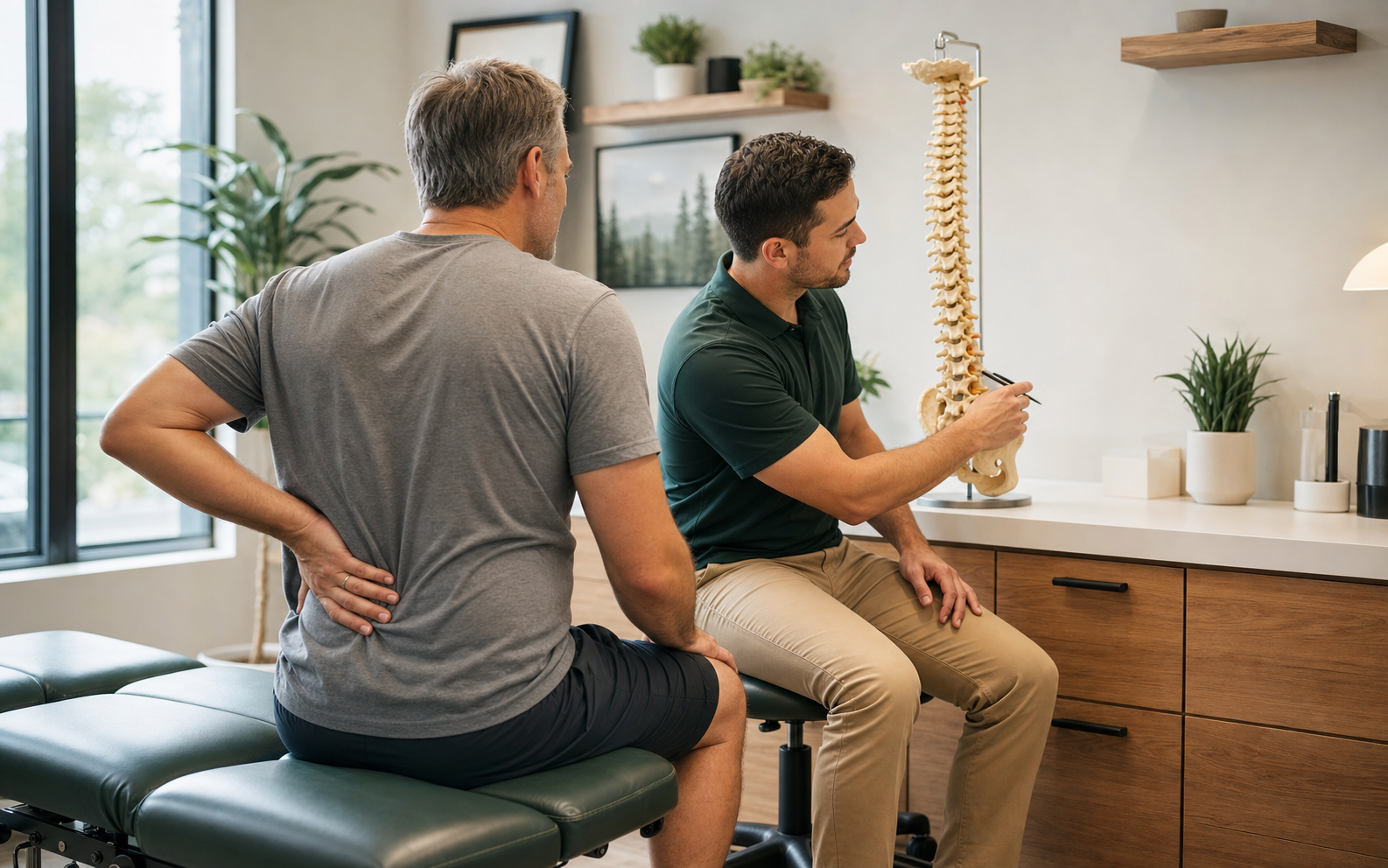
The evaluation starts with your specific pain pattern, activity level, and what makes symptoms better or worse. The physical exam tests lumbar range of motion, hip mobility, glute and core activation, and neurological function when radiating symptoms are present. Orthopedic testing separates facet joint problems from disc involvement, SI joint dysfunction, and hip pathology — each of which responds to different care.
Treatment may include lumbar and sacral adjustments, soft tissue work on tight hip flexors, glutes, and paraspinals, core stability guidance appropriate for your fitness level, and practical modifications for Denver’s blend of desk work and outdoor recreation. Most acute lower back pain improves significantly within several weeks of consistent chiropractic care. Call (303) 529-4198 to schedule your lower back pain evaluation.